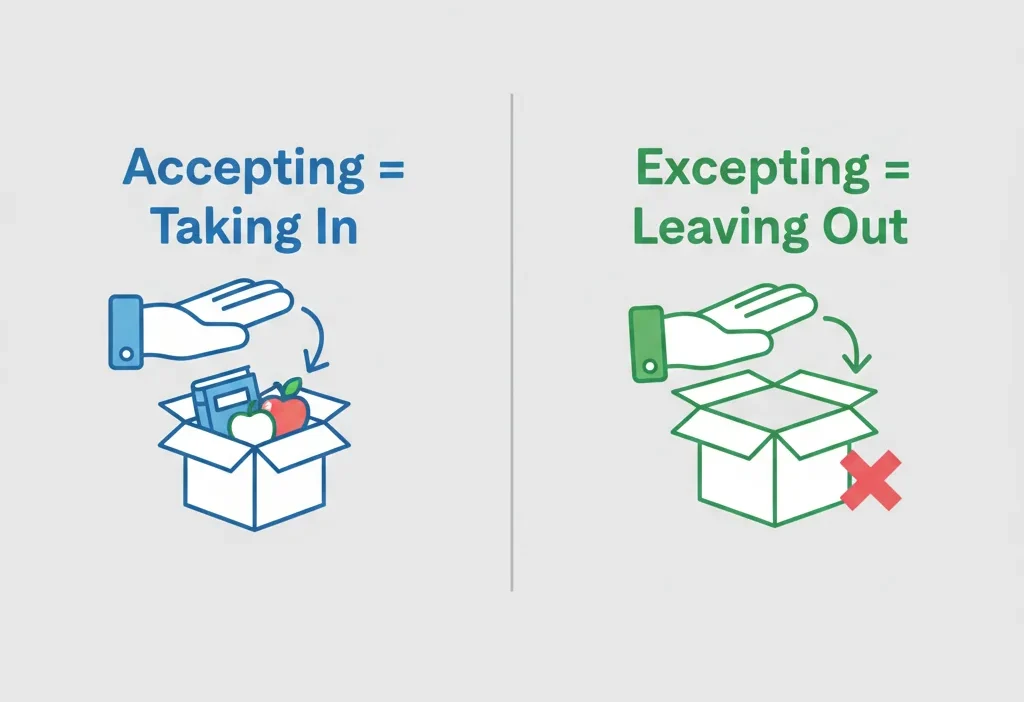
Accepting means agreeing to receive, approve, or take something.
Excepting means excluding or leaving something out.
Examples:
- ✅ I am accepting your apology.
- ❌ Everyone was invited, excepting John.
If you are saying “yes” to something, use accepting.
If you are leaving something out, use excepting.
Have you ever paused while writing an email, wondering whether to use excepting or accepting? You’re not alone. Many people search for excepting vs accepting because these two words look similar, sound close, and are often mixed up in daily writing. One small spelling change can completely flip the meaning of a sentence.
This confusion often appears in professional emails, school assignments, news writing, and even social media posts. People also ask questions like: Is it accept or except my apology? or What is the difference between accepting and taking? These are valid concerns because using the wrong word can make your message unclear or incorrect.
This guide solves that confusion once and for all. You’ll get a quick answer, simple explanations, real-life examples, grammar tips, and professional advice on which word to use and when. By the end, you’ll confidently know the difference between accepting vs excepting, and you’ll never mix them up again.
The Origin of Excepting vs Accepting

Understanding where words come from makes them easier to remember.
Accepting
- Origin: Latin acceptare
- Meaning: to receive willingly
- Entered English through Old French
Excepting
- Origin: Latin excipere
- Meaning: to take out or exclude
The spelling difference exists because the words come from different Latin roots with opposite meanings. Over time, English kept both words, even though they look and sound similar.
That’s why accepting vs excepting is not just a spelling issue—it’s a meaning issue.
British English vs American English Spelling
Good news: there is no spelling difference between British and American English for accepting and excepting.
However, usage frequency can differ slightly by region.
Comparison Table: British vs American Usage
| Aspect | British English | American English |
|---|---|---|
| Accepting | Common | Common |
| Excepting | Rare, formal | Rare, formal |
| Everyday use | Prefer “except” | Prefer “except” |
In both regions, excepting is more formal and less common than except.
Which Spelling Should You Use?
Your choice depends on meaning, not location.
Use “Accepting” if you mean:
- Agreeing
- Receiving
- Taking willingly
✅ She is accepting the job offer.
Use “Excepting” if you mean:
- Excluding
- Leaving something out
✅ All items are free, excepting alcohol.
Audience-Based Advice
- US audiences: Use accepting or except (avoid excepting if possible)
- UK/Commonwealth: Same rule applies
- Global audience: Choose clarity—accepting or except
Common Mistakes with Excepting vs Accepting
Here are the most frequent errors people make:
❌ Mistake 1:
“I am excepting your apology.”
✅ Correction: “I am accepting your apology.”
❌ Mistake 2:
“Everyone was invited accepting Sarah.”
✅ Correction: “Everyone was invited excepting Sarah.”
❌ Mistake 3:
Confusing accept, except, and expect
| Word | Meaning |
|---|---|
| Accept | Receive |
| Except | Exclude |
| Expect | Anticipate |
This is why people search accept vs except vs expect so often.
Excepting vs Accepting in Everyday Examples
Emails
- ✅ I am accepting the meeting request.
- ❌ I am excepting the meeting request.
News
- The policy applies to all citizens, excepting minors.
Social Media
- Accepting new clients this week!
- Open daily, excepting Sundays.
Formal Writing
- The organization is accepting donations.
- All rules apply, excepting emergency cases.
Excepting vs Accepting – Google Trends & Usage Data

Search data shows:
- Accepting is searched far more often
- Excepting appears mainly in legal and formal writing
- Common searches include:
- Excepting vs accepting meaning
- Accept and except in a sentence
- Excepting vs accepting grammar
Popularity by Region
- US, UK, India: High searches for accept
- Legal contexts worldwide: Limited use of excepting
Comparison Table: Accepting vs Excepting
| Feature | Accepting | Excepting |
|---|---|---|
| Meaning | Receiving | Excluding |
| Common use | Very common | Rare |
| Tone | Neutral | Formal |
| Example | Accepting help | Excepting errors |
FAQs
1. What is the difference between accepting and excepting?
Accepting means receiving. Excepting means excluding.
2. Is it “accept” or “except” my apology?
Correct: accept my apology.
3. Are accept and except homophones?
Yes. They sound the same but have different meanings.
4. What is the difference between accepting and taking?
Accepting implies agreement. Taking may not.
5. Is excepting still used in modern English?
Yes, but mostly in formal or legal contexts.
6. Can excepting replace except?
Sometimes, but except is more natural.
7. How can I remember the difference?
Accept = Agree. Except = Exclude.
Conclusion
Understanding excepting vs accepting is a small skill with a big impact. These two words may look alike, but they carry opposite meanings. Accepting is about receiving, agreeing, and welcoming something. Excepting is about excluding or leaving something out. Mixing them up can confuse readers and weaken your message.
The key is intent. Ask yourself one simple question: Am I saying yes, or am I leaving something out? If you’re saying yes, choose accepting. If you’re excluding something, choose excepting (or better yet, except in everyday writing).
Whether you’re writing emails, articles, academic work, or social media posts, using the correct word builds clarity and professionalism. Now that you understand the meaning, grammar, and real-world usage, you can write with confidence and avoid one of English’s most common word traps.

Samuel Hargrove is a spiritual writer specializing in numerology, angel numbers, and divine guidance. He helps readers understand the deeper meaning behind numbers and their life paths.