Parent is singular. It means one mother or one father.
Parents is plural. It means both mother and father, or more than one parent.
Examples
- My parent signed the form. (one person)
- My parents signed the form. (two people)
Parents vs parent meaning depends on number, not formality.
If you mean one, use parent.
If you mean more than one, use parents.
One small word. One tiny “s.” And yet, parents vs parent confuses millions of people every day. 😅
Is it parent meeting or parents meeting? Should you write parent’s signature or parents’ signature? And why does Google show mixed answers when you search “Is parents plural or singular?”
This confusion happens because parent can be singular, plural, or possessive—and each form changes meaning completely. Students, teachers, bloggers, legal writers, and even native English speakers struggle with this keyword. That’s why people search parents vs parent grammar, parents vs parent meaning, and even debate it on Parents vs Parent Reddit threads.
This article solves that confusion once and for all. You’ll get a quick answer, clear rules, real-life examples, comparison tables, and professional usage advice. No complex grammar. No jargon. Just simple, correct English.
If you’ve ever paused before typing parent or parents, this guide is for you.
The Origin of Parents vs Parent
The word parent comes from the Latin word parens, meaning father or mother. In Middle English, it entered as parent, referring to one caregiver.
The plural parents simply follows standard English plural rules by adding -s. Over time, confusion grew because schools, legal systems, and institutions often talk about both parents together, making parents more common in official language.
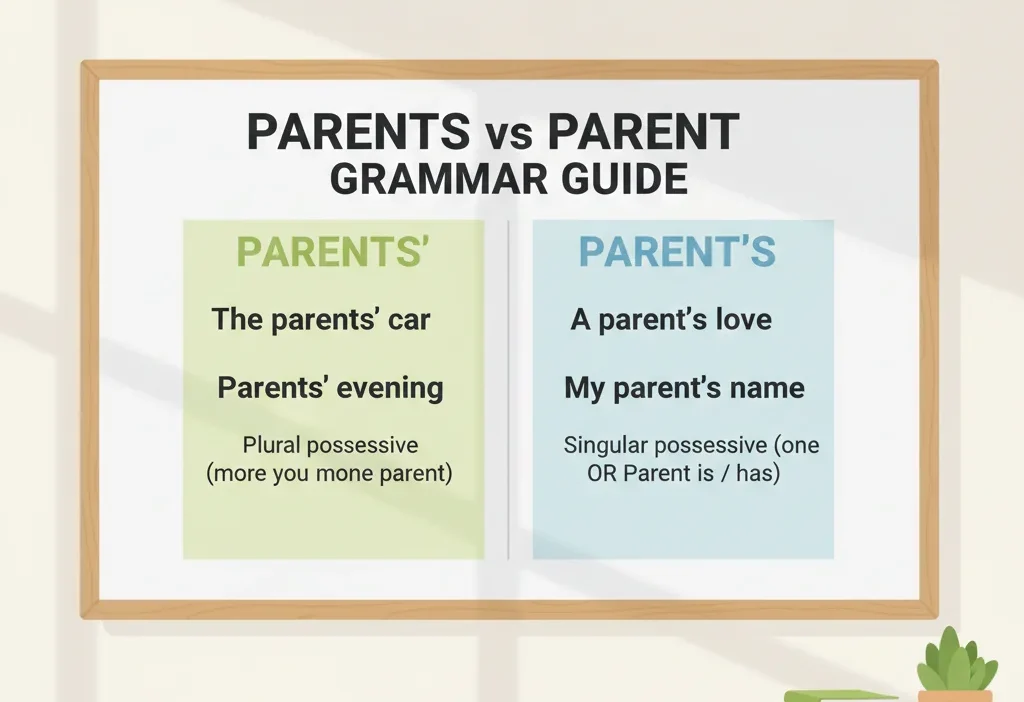
Spelling differences do not change meaning here. The confusion exists because English also uses apostrophes, which change ownership:
- parent’s → belonging to one parent
- parents’ → belonging to more than one parent
British English vs American English Spelling
There is no spelling difference between British and American English for parent or parents. The rules are the same worldwide.
Comparison Table
| Form | Meaning | Example |
|---|---|---|
| parent | singular | One parent attended |
| parents | plural | Both parents attended |
| parent’s | singular possessive | Parent’s signature |
| parents’ | plural possessive | Parents’ signatures |
✔ Used the same in the US, UK, Canada, Australia, and global English.
Dye vs Die 🔥 The Tiny Detail Most People Get Wrong
Which Spelling Should You Use?
Choose based on audience and meaning, not location.
- US audience → Follow the same grammar rules
- UK/Commonwealth → Same usage applies
- Global writing → Be clear and specific
Professional Tip
In schools, legal documents, and workplaces:
- Use parents when policies apply to both guardians
- Use parent when referring to one individual
Accuracy builds trust and authority.
Common Mistakes with Parents vs Parent
Here are frequent errors and fixes:
❌ Parents meeting will be held tomorrow.
✔ Parents’ meeting (meeting for parents)
❌ My parents signature is missing.
✔ My parents’ signature is missing
❌ One of the parent is late.
✔ One of the parents is late
❌ Is parent plural?
✔ Parents is plural; parent is singular
These mistakes are common in emails, notices, and exams.
Parents vs Parent in Everyday Examples

Emails
- Please ask your parent to reply.
- All parents must attend.
News
- Concerned parents protested the policy.
Social Media
- Shoutout to every single parent doing their best.
- My parents are my heroes.
Formal Writing
- Each parent must submit identification.
- Consent from parents is required.
Parents vs Parent – Google Trends & Usage Data
Search data shows parents is more popular than parent globally. Why?
- Schools use parents often
- Forms target both guardians
- Searches like Parents vs Parent Reddit show ongoing confusion
Popular by Context
- Parent → legal, singular responsibility
- Parents → education, family, policy
Understanding context improves clarity and SEO relevance.
👉 Somebody vs Someone: What’s the Difference?
Keyword Comparison Table
| Keyword | Usage |
|---|---|
| Parents vs parent grammar | Rule explanation |
| Parents plural possessive | Parents’ |
| Your parent or parents | Depends on one or two |
| Parents or parents meeting | Parents’ meeting |
| One of the parent or parents | One of the parents |
FAQs: Parents vs Parent
Is it correct to say parent or parents?
Yes. Use parent for one, parents for more than one.
Is parents plural or singular?
Parents is plural.
Which is correct, parent’s signature or parents’ signature?
One parent → parent’s signature
More than one → parents’ signature
Is parent 1 mom or dad?
Yes. Parent means either mother or father.
Your parent or parents—what’s correct?
Use parent if one is involved, parents if both are.
Parents or parents meeting?
Correct form: Parents’ meeting
One of the parent or parents?
Correct: One of the parents
Conclusion
The difference between parents vs parent is small but powerful. One extra letter can change meaning, ownership, and clarity. Parent refers to one individual. Parents refers to more than one. Add apostrophes carefully, and the confusion disappears.
This topic matters because it affects exams, legal forms, school notices, and professional writing. Knowing when to use parent, parents, parent’s, or parents’ makes your English accurate and confident.
If you remember one rule, remember this:
👉 Meaning first. Grammar second.
Once you know how many people you’re talking about, the correct word becomes obvious. Keep this guide handy, and you’ll never second-guess parent again.